Jacques Derrida
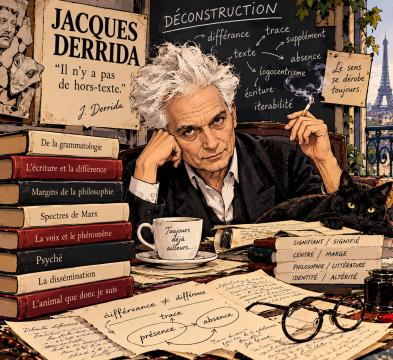
Jacques Derrida (El Biar, Algeria, July 15, 1930 – Paris, October 9, 2004) was a French philosopher of Algerian descent, one of the most influential thinkers of the second half of the 20th century, and the originator of deconstruction—a philosophical approach that re-examines established conceptual oppositions, the meaning of language, and the foundations of Western metaphysics.
He was born into a Jewish family in what was then French Algeria. After completing his schooling in Algeria, he moved to Paris, where he studied philosophy at the prestigious École normale supérieure. He taught at both French and American universities and was particularly associated with the École des hautes études en sciences sociales in Paris.
He gained international attention in 1967 with the publication of three key books: Of Grammatology, Writing and Difference, and Speech and Phenomena. In these works, he developed a critique of logocentrism—the philosophical tradition that privileges speech and immediate presence over writing and difference.
A central place in his philosophy is occupied by the concept of différance, a term he uses to denote the simultaneous processes of differing and deferring meaning. Derrida demonstrates that meaning is neither fully closed nor definitively fixed; rather, it emerges through the relationships between signs and their contexts. His important works include Dissemination (1972), Margins of Philosophy (1972), The Truth in Painting (1978), The Post Card (1980), Psyche: Inventions of the Other (1987), and Specters of Marx (1993). In his later works, he increasingly addressed issues of justice, hospitality, forgiveness, democracy, ethics, and political responsibility.
His book The Animal That Therefore I Am is dedicated to the relationship between humans and animals and to a critique of the traditional understanding of human exceptionalism.
Derrida’s thought has profoundly influenced philosophy, literary theory, critical studies, law, and architecture. Although deconstruction has sparked numerous debates and challenges, it remains one of the most important approaches to contemporary thinking about language, identity, culture, and meaning.
Titles in our offer
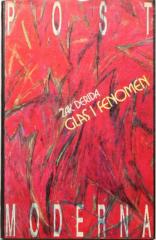
Glas i fenomen: Uvod u problem znaka u Husserlovoj fenomenologiji
An early masterpiece of deconstruction in which Derrida analyzes Husserl's phenomenology. Through a critique of the privileging of the living voice and presence, the author establishes the notion of the letter and develops a critique of the metaphysics of